
The Agentic AI
Hardware Firewall.
Hardware-enforced safety for autonomous intelligence.
A dedicated co-processor on separate silicon that checks every AI action against loaded rules at runtime, withholds any violation, and keeps a signed record of every decision.
Software guardrails run on the same computer as the AI they police
They can be bypassed. Published research demonstrates universal adversarial attacks against aligned models.
The bigger cost is usually not an incident but a deployment that never happens, because nobody can prove which agent acted, on whose authority, or why it was permitted.
For autonomous systems in robotics, finance and critical infrastructure, usually safe is not good enough.
Usually safe is not good enough.
Software guardrails can be talked past.
Evrmind enforcement sits where the AI cannot reach it.
The regulatory position
EU AI Act. Transparency obligations apply from 2 August 2026.
- •High-risk obligations deferred to 2 December 2027 and 2 August 2028 under the Digital Omnibus, approved 29 June 2026, because the compliance infrastructure was not ready in time.
- •Mandatory conformity assessments, risk management systems and incident reporting for high-risk AI systems.
- •DORA requires financial institutions to evidence operational resilience across their ICT estate, including systems they do not operate themselves.
- •Penalties up to €35 million or 7% of global turnover.
Boards must now declare their controls effective, not merely present.
- •FRC Provision 29 of the UK Corporate Governance Code applies to financial years beginning on or after 1 January 2026. Boards must declare the effectiveness of material controls, now including operational controls, on a comply or explain basis.
- •FCA Consumer Duty requires firms to evidence good outcomes, not documented intentions.
- •Sector regulators are already enforcing within existing powers: FCA, ICO and MHRA.
- •The AI Security Institute conducts safety evaluations on frontier systems.
State frameworks are being rewritten, not withdrawn.
- •Colorado repealed and replaced its AI Act in May 2026 with a narrower automated decision-making disclosure regime, effective 1 January 2027.
- •Impact assessments, transparency disclosures and consumer protections are required across multiple states.
- •The White House National Policy Framework for AI was published on 20 March 2026.
A policy states an intention. Evrmind produces the evidence: a signed record of every AI decision, generated in hardware, independent of the system being governed.
Enforcement outside the AI's reach
A dedicated safety co-processor on separate silicon. Every proposed action is checked against the loaded rules, a signed record is produced, and a physical gate withholds anything that fails. Deterministic by design.
Separate silicon
Enforcement sits outside the AI's trust domain, so the AI cannot reprogram, bypass or reach it. It keeps working when the link is lost, and it is designed to keep working if the software stack is compromised.
Deterministic by design
Every action is checked against the loaded rules before it can execute. Default state is deny.
One constitution
Safety rules are written once and compiled to hardware-enforced logic. Robotics limits, airspace rules, clinical constraints. Same chip, different rules, updated through authenticated provisioning.
The Signal Path
The PAGE pipeline: Proof, Attest, Govern, Enforce.
PROOF
Rule checkA checkable proof that the loaded rules were applied. Every action is checked before it can execute.
ATTEST
Cryptographic recordA signed, tamper-evident record of every decision, generated in hardware. Any auditor, regulator or partner can verify the system obeyed its rules without access to the AI or its data.
GOVERN
Constitutional rulesLoadable constitutional rules for any industry. Robotics safety, financial compliance, surgical constraints, infrastructure limits. Same chip, different rules.
ENFORCE
Physical interdictionEnforcement on separate silicon. The AI cannot reprogram or reach the safety processor. If the check fails, the command is withheld.
Where we are
Full pipeline validated at TRL 4 on Zynq 7020.
Filed at UKIPO across the architecture
Six papers on enforcement, limits, and deterministic foundations. On Zenodo.
Signed with an ESA-backed satellite communications operator
OGEL and GEA export licences secured.
Try it yourself
Send a command, watch the gate decide
Try an action
Send a command and watch it clear the safety gate, or get withheld.
Idle. Send a command to begin.
Decision log
No decisions recorded yet.
State readout
Rule
altitude ≤ 120 m
State
altitude 88 m · GPS fresh
Verdict
READY
Execution log
// Send a command to trace the pipeline.
Decision record
// Send a command to produce a signed decision record.
Feedback to host
// The host AI receives a structured verdict after each decision or notice.
The AI receives a structured verdict and the rule that was breached. There is no natural language, because the chip has no model in it.
Illustrative browser simulation. Not connected to the FPGA. Timings and record values are representative.
Watch it enforce
Hardware safety layer, validated on FPGA
EvrChip on a Xilinx Zynq 7020, between the AI processor and the actuator it controls. Once armed, every action the AI proposes is checked in hardware against the operator's loaded rules. When a command breaks a rule, the action is withheld and never reaches the actuator. A denial is made in hardware the AI cannot reach, and every decision, permitted or denied, is signed and recorded. Illustrative: the chip sits before the actuator and cuts it.
Keep the record
Decision record, a signed proof of every verdict
What the operator sees. Every proposed action, its verdict, and a signed, tamper-evident proof of the decision. This is an illustrative dashboard of the chip's runtime output; on the chip, the record is generated in hardware.
Where it is usedIllustrative applications.

DRONES AND UNCREWED SYSTEMS
Airspace rules, geofences and operational envelopes enforced on the aircraft, from independent position and state data rather than the autonomy's own interpretation. Enforcement holds when the link does not.
Outcome: Beyond visual line of sight operations backed by evidence a regulator can verify.

ROBOTICS AND INDUSTRIAL AUTOMATION
Collaborative robots, warehouse automation and industrial control. Force, speed and proximity limits are verified in hardware before the actuator moves, independent of the controller that proposed the motion.
Outcome: Robots working alongside people, with a safety case that does not depend on the controller behaving.

AUTOMOTIVE AND AUTONOMOUS VEHICLES
The automotive industry already accepts that safety belongs on separate silicon: lockstep cores, safety islands, ASIL-rated parts. Those answer whether the hardware is working. Evrmind answers whether the action is permitted.
Outcome: A familiar pattern applied one layer up, from component integrity to decision authority.

CRITICAL INFRASTRUCTURE AND ENERGY
Grid switching, load balancing and control decisions where a single incorrect action cascades. Safety and regulatory limits are enforced between the control AI and the plant.
Outcome: Autonomy in the control room that the safety case can actually accommodate.

FINANCE AND BANKING
Autonomous execution, payments and risk decisions at machine speed. Every action carries a cryptographic record of what was checked and on whose authority, generated in hardware.
Outcome: The audit evidence exists before anyone asks for it.

MEDICAL AND CLINICAL AI
Surgical robotics, dosing and clinical decision support. If a proposed action falls outside the loaded patient safety parameters, the output is held at logic zero and the action does not reach the patient.
Outcome: Clinical safety that can be certified rather than trusted.

AGENTIC AI FOR ENTERPRISE
Coding assistants, DevOps agents and autonomous workflows holding real credentials and real system access. Every action is checked against its authority before it executes.
Outcome: Agents given the access that makes them useful, because you can prove where the boundary is.

SPACE AND SATELLITE AUTONOMY
Orbital manoeuvres, collision avoidance and payload operations decided on board, where ground confirmation may be minutes away or unavailable. Mission rules are enforced at the point of action, regardless of the state of the link.
Outcome: Autonomy in orbit that stays inside its mission envelope, with a signed record for ground review.
Work With Us
Full pipeline running end to end on FPGA. Design partners shape the integration, the operating context, the rules and the interface.
FAQs
01What is hardware-enforced AI safety?
Safety rules enforced by a physical circuit rather than by software. A dedicated co-processor verifies every action an AI proposes and blocks anything that violates the loaded rules. Because the enforcement is separate silicon, the AI cannot reprogram or bypass it.
02Why are software guardrails not enough?
Software guardrails share the same memory and processor as the AI they police, so a compromised or jailbroken system can bypass them. Published research demonstrates universal adversarial attacks against aligned models. Hardware enforcement sits outside the AI's trust domain.
03What is an AI safety co-processor?
A separate chip placed between an AI system and its actuators. Evrmind's co-processor checks each proposed action against loaded rules at runtime, produces a signed record of the decision, and physically gates the output. Default state is deny.
04How fast is hardware interdiction?
No action reaches the actuator until granted. Prototype: up to about 0.2 s per decision. Production target: under 1 ms.
05Does it require changes to the AI model?
No retraining, no change to the AI. The co-processor sits in the actuation path; integration is at the governed interface.
06What evidence does it produce for regulators and auditors?
A signed, tamper-evident record of every decision, generated in hardware. An auditor, regulator or partner can verify the system obeyed its rules without access to the AI or its data.
Choose the deployment model that fits your requirements.
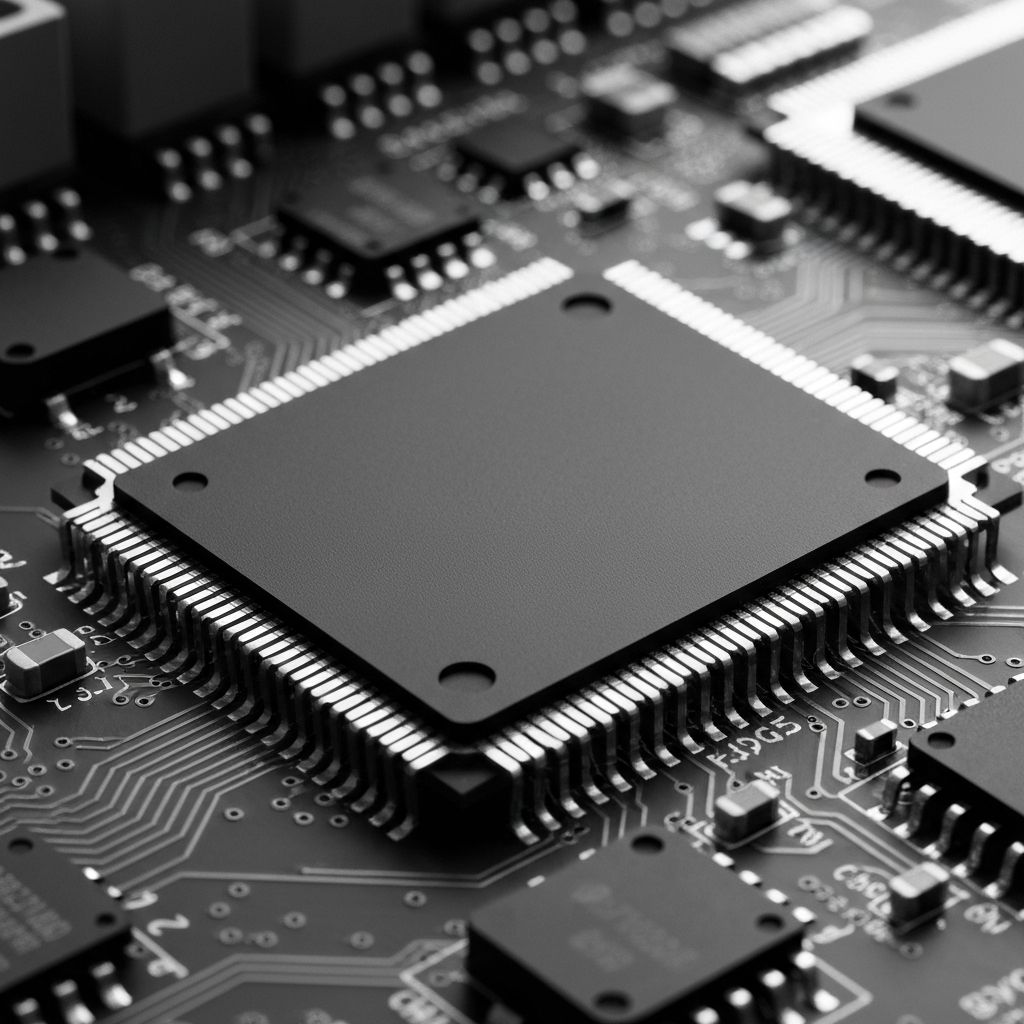
EVRCHIP
Hardware deploymentEnforcement on separate silicon. The AI cannot reprogram or reach the safety processor. If the check fails, the command is withheld.

EVRGUARD
Cloud deploymentDeterministic mathematical verification as a service. The same engine that powers our chip, deployed as a cloud API. There is no model to jailbreak and no weights to poison. For enterprises where software controls execution.
Interested in hardware-enforced AI safety?
Enforcement for the systems where a wrong action has real consequences.